A Community Service of Witness and Worship
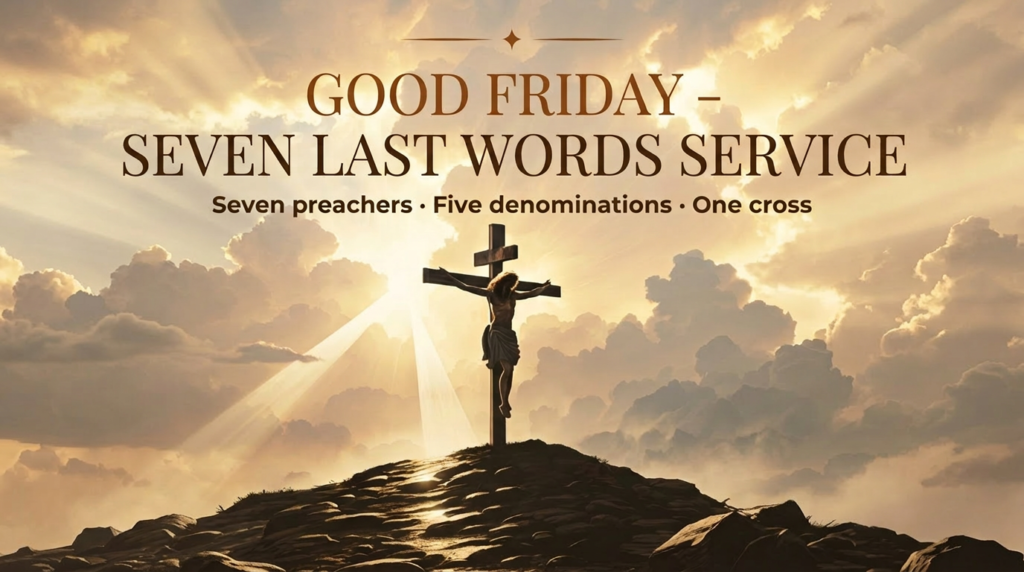
Gordonsville Ecumenical Good Friday Service – April 3, 2026
On Good Friday, Christians around the world gather in reverent silence to remember the crucifixion of Jesus Christ. It is the day we stand at the foot of the cross — gazing upon divine love poured out for the salvation of the world. The Seven Last Words from the Cross are brief yet profound statements, recorded across the four Gospels, that express the deepest truths of faith, suffering, mercy, and redemption.
This year’s Gordonsville Community Good Friday Service brought together nine congregations represented by seven pastors to meditate on each of these seven words. What follows is a written summary of the messages shared for each word during the service. To experience the full worship service, including scripture, music, and complete sermons, you are warmly invited to watch the recording here:
Full Service Video: https://youtube.com/live/MK9yc52ZkWg?feature=share
As we reflect together, may these words open our hearts to the mystery of grace and the beauty of surrender.
“Father, forgive them, for they do not know what they are doing.”
Luke 23:34
Rev. Ralph Rowley — Aldersgate United Methodist Church, Charlottesville
Jesus’ first word from the cross is a prayer — and astonishingly, it is for his executioners. Amid scorn and cruelty, Jesus looks upon the faces of those who have nailed his body to the wood and speaks mercy rather than condemnation. In those words, “Father, forgive them,” the Son reveals the heart of the Father — a heart that never stops reaching out to the lost, even when humanity turns its back. This prayer fulfills what Jesus taught when he said, “Love your enemies and pray for those who persecute you.”
In forgiving others even while suffering, Jesus rewrites the story of human retaliation and pride. He shows us that prayer is not only a way to speak to God but to release God’s love into the world’s darkest corners. The call to forgive, even when wronged, is a call to participate in Christ’s redemptive work. Through this word, we are reminded that forgiveness is not weakness, but holy strength — the victory of love over hate.
“Truly I tell you, today you will be with me in paradise.”
Luke 23:43
Rev. Jair Serrano — Bethel United Methodist Church / Mountain View United Methodist Church
A condemned man hanging beside Jesus confesses his guilt and declares faith: “Jesus, remember me when you come into your kingdom.” The reply he receives is immediate and beautiful — “Today you will be with me in paradise.” These are words of assurance given to one who has nothing left to offer but trust. They proclaim that salvation is not earned; it is received. God’s grace meets us where we are, even in our last moments, and restores what sin has broken.
Through this exchange, Jesus demonstrates that divine mercy is not limited by time or circumstance. “Today” signals that life in Christ begins now — whenever we turn toward him. The thief becomes the first believer to enter paradise, reminding us that no sinner is beyond the reach of redemption. In his dying breath, Jesus extends compassion to all who will come, showing that the gate of heaven opens not through merit but through grace.
“Woman, here is your son. … Here is your mother.”
John 19:26–27
Rev. Lachlan S. Hassman — Christ Episcopal Church, Gordonsville
From the cross, Jesus looks upon his mother Mary and the disciple whom he loved. His words form a new bond: “Woman, here is your son… Here is your mother.” Even in agony, Jesus turns his attention to compassion and care. Mary’s heart, pierced with grief, finds comfort in John’s presence — and John, in turn, becomes her son within a family born not of blood but of love. This word redefines community as Christ intends it to be — a family of shared faith and mutual support.
Beyond the immediate scene, this word speaks to the church’s calling. We are made into one body at the foot of the cross. Jesus establishes the church as a community that tends to the hurting, grieves together, and bears one another’s burdens. Love does not turn away from suffering; it dwells within it, seeking connection even there. In Mary’s sorrow and John’s obedience, we glimpse the foundation of the fellowship Christ creates — bound together by grace and care.
“My God, my God, why have you forsaken me?”
Matthew 27:46
Rev. Jason Bird — Gordonsville Baptist Church
These piercing words, echoing Psalm 22, reveal the depth of Jesus’ identification with human anguish. Hanging between heaven and earth, the Son of God cries the ancient words of Israel’s lament. Though the sound is one of desolation, its substance is faith — a prayer rooted in Scripture and trust. Through this word, Jesus enters fully into the pain of human isolation and the silence that often surrounds suffering.
This is not a cry of defeat but of revelation. Jesus bears the distance between humanity and God so that we need never face such abandonment alone. In the psalm he quotes, the suffering one eventually proclaims victory: “They shall come and declare his righteousness to a people yet unborn.” Thus, this word carries prophecy as much as pain — announcing that even in apparent forsakenness, God’s purpose continues. The cry of the crucified becomes the cry of every believer who finds assurance that no darkness can hide us from divine love.
“I am thirsty.”
John 19:28
Rev. Charles Lewis — Union Baptist Church
After carrying the sins of humanity and enduring unimaginable torment, Jesus utters a simple, human phrase: “I am thirsty.” These words fulfill the psalmist’s prophecy and remind us of the full humanity of Christ. The one through whom living water flows experiences the dryness of mortal thirst. This moment invites us to recognize the physical reality of Jesus’ suffering — not as weakness, but as sacred participation in human pain.
Yet spiritually, this word carries richer meaning. Jesus thirsts for righteousness, for reconciliation, for the world’s redemption. His thirst mirrors our own longing for peace and healing. When we allow his thirst to dwell in us, it becomes the desire that draws us back to God and to one another. The living water offered to the Samaritan woman now flows through this moment of human need — proving that in Christ, even thirst becomes a doorway to grace.
“It is finished.”
John 19:30
Rev. Dana Peebles-Thadikonda — Somerset Christian Church
With a loud voice, Jesus cries out, Tetelestai — “It is finished.” In this single word, all history pivots. The mission for which he came — to reconcile humanity to God — is complete. The work is not ended in defeat but accomplished in victory. Christ has paid the debt of sin, fulfilled every prophecy, and secured everlasting peace between Creator and creation. This is the cry of the conqueror, not the vanquished.
We might imagine the sigh of relief as heaven’s plan reaches its fulfillment. No longer must sacrifices be offered again and again; the Lamb of God has done what no one else could do. The bowing of Jesus’ head is not resignation but reverent submission — a gesture of peace, willingly offered. “It is finished” speaks into our lives as well, inviting us to rest in the completed work of Christ. The striving ends. The grace stands. The cross declares it finally and forever: Redemption accomplished.
“Father, into your hands I commend my spirit.”
Luke 23:46
Rev. Joyce Rodgers — Gordonsville United Methodist Church / Barboursville United Methodist Church
As Jesus breathes his last, he prays the words every Jewish child would have known from Psalm 31 — a prayer uttered nightly before sleep: “Into your hands I commit my spirit.” With this final breath, Jesus entrusts his very essence to the Father’s care. His death is not defeat; it is the faithful surrender of the Son to the One he has trusted from eternity. The curtain of the temple tears, and the boundaries between heaven and earth dissolve. In the breaking of God’s heart, new creation rushes forth.
These words remind us that the cross is both suffering and birth — pain leading to life restored. Just as a mother labors to deliver new creation, Christ’s agony gives way to resurrection. To commend our spirits to God, as Jesus did, is to place our fears and restlessness into divine hands. In doing so, we discover peace — the rest that Augustine called the soul’s true home: “Our hearts are restless until they rest in thee.” In the end, trust is the truest act of faith and surrender the doorway to resurrection.
Conclusion
As we reflect on the Seven Last Words, we encounter the full measure of divine love: forgiveness for enemies, hope for the lost, care in suffering, faith amid silence, compassion in human frailty, victory over sin, and peace through surrender. This Good Friday service, shared by nine congregations and seven preachers, is a living sign that the cross draws us together across traditions in the unity of Christ.
The reflections above offer only a glimpse of what was proclaimed and prayed in worship; to hear each message in full and join in the hymns and prayers, please visit the full-service recording: https://youtube.com/live/MK9yc52ZkWg?feature=share.
As you watch and pray, may you find yourself echoing Jesus’ final word of trust:
“Father, into your hands we commend our spirits.”