Faith is personal — but it was never meant to be private.
Rev. Joyce Rodgers
May 10, 2026
Ancient Words, Today’s Faith – Week 4| Acts 2:37–47
As our profession continues, we respond to the words the crowd cried out to the disciples, “Brothers, what should we do?”
We have acknowledged who God is – that God is parent; God is almighty; God is creator. We have affirmed that Jesus is son, God, and born of Mary, human – we know that Jesus possesses both the character of a human and the divine fully and simultaneously. We know him as Christ, Lord and judge. We can find ourselves in his story and him in ours – and through this are challenged and hopeful. Like those who witnessed Peter’s sermon on the day of Pentecost, we wonder what it is we are to do now that we have all this knowledge. We have learned that we are meant to love the Lord our God and love our neighbor as ourselves, but how?
Our Creed continues by anchoring our next steps in the third member of the Trinity – The Holy Spirit. God incarnate has ascended. Jesus no longer is physically present with us today. However, Jesus didn’t leave us stranded. His Spirit was poured over the world offering us an immediate means of connecting and communicating with God.
The One We Have Difficulty Conceptualizing
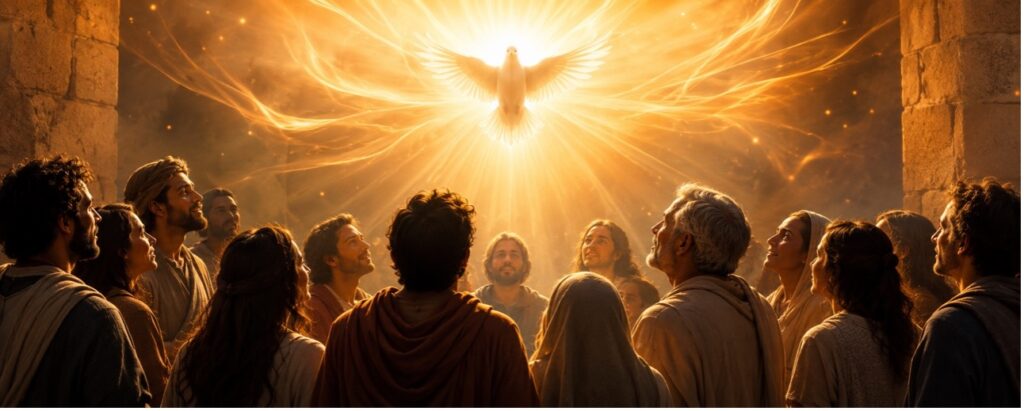
For many folks, the Holy Spirit is the one member of the Trinity that we have difficulty conceptualizing. In scripture we have seen the Holy Spirit represented as breath or wind, fire, and a dove. These representations are harder for us to connect to in a relational way. While the Apostles’ Creed doesn’t elaborate on the qualities or nature of the Holy Spirit, we understand the Spirit’s critical role simply by being present in the creed.
The Nicene Creed, which is born out of the Apostles’ Creed, sought to offer clarity – particularly around the Trinity and even more particularly regarding the Holy Spirit, which didn’t receive the same level of attention in the Apostles’ Creed as God the Father and Jesus. In this Creed, we assert that we “believe in the Holy Spirit, the Lord, the giver of life, who proceeds from the Father and the Son, who with the Father and the Son is adored and glorified, who has spoken through the prophets.”
Growing up, my faith was a very personal and individual thing – without a family faith foundation and because of military moves, without a church home or faith community, my faith grew through what I would now call prayer – others might call introspection. God the Father felt intimidating to me. Jesus, honestly, at that time was confusing to me – between the virgin birth and miracles and resurrections – there was a lot for my young, rational mind to wrestle with. The Holy Spirit though, God’s presence that surrounded me and was within me, that not only made sense but connected well with my experience of God speaking to me when I turned inward. While many grow up with a strong understanding or connection to God or Jesus, I had the Holy Spirit. I think, at least in part, because of this, I am always moved by these words from the Nicene Creed.
The Spirit Is Also Lord
We see in this Creed that the Holy Spirit is also identified as Lord – God is Lord, Yahweh. Jesus is Lord and Savior. The Spirit is also Lord – a Lord that is an ongoing presence in our lives. As we have been called to be obedient to the Lord of the Old Testament, God, and the Lord of the Gospel, Jesus – we are also called to be obedient to the Lord we find in the Holy Spirit. When we wonder, as those early believers did, what we need to do now – Peter offers direction – “Repent, and be baptized every one of you in the name of Jesus Christ so that your sins may be forgiven; and you will receive the gift of the Holy Spirit.”
The Holy Spirit is present and accessible to every single person. While Jesus was Emmanuel, God with us – the Holy Spirit is God within and around us. We understand this through our understanding of prevenient grace, which tells us that the Holy Spirit works within each person, drawing them into a relationship with God. The true gift of grace isn’t realized until we accept this gift and through the Holy Spirit experience justification. This experience of justification is initiated through that word “repent.” When we repent, we recognize God’s authority and desire to be aligned and in right relationship with God. When we do this, we move away from a state of sin and into a state of grace.
What we notice in our reading from Acts this week is that Peter didn’t just tell them to repent and be baptized and then everyone headed back home afterwards. What happened next allows us to see the power of the Holy Spirit, through our repentance and baptism, building community. As the people became justified through grace, they devoted themselves to teaching and fellowship, to communion and prayer. They shared things in common. They shared resource to meet one another’s needs. They gathered daily and had glad and sincere hearts that praised God. This is what the Spirit does — the Spirit doesn’t just change individuals; the Spirit forms a people.
Through this act of repentance, we fully accept the gift of the Holy Spirit that Peter spoke about. In accepting this gift, we accept a position of awe and humility and allow the Holy Spirit – that we are now more fully connected with – to work in and guide our lives. We enjoy an experience of sanctifying grace, as through obedience to our Lord, the Holy Spirit, we are guided in closer alignment with God and more fully express the image of God with which we were created. To fully love God, as we are called to, we must fully love the Holy Spirit – as God is not just God the Father or Jesus Christ, but also the Spirit.
Baptism: Not About Avoiding Something
Peter also said that we must become baptized. Fully submitting ourselves to our Lord God, Lord Jesus, and Lord Holy Spirit requires more than simply repenting – it requires baptism.
When I was small, my mother insisted on NOT having me baptized. She was very insistent that neither she, my father, nor any other person would establish my faith for me. She left all doors open and felt like baptizing me would dictate a certain religious endorsement. As I moved from school to school and church to church, I was confronted with people who routinely told me that I better get baptized so I wouldn’t go to hell. After hearing these words so often, I spent a lot of time thinking about what I believed. (While there were some obstacles because of my mother’s decisions about my faith upbringing, a great gift I received was that from a really early age I learned to be very reflective and prayerful about what others told me about faith.) I eventually decided that I didn’t believe I had to be baptized to be saved from hell. Our theological tradition as United Methodists supports this belief.
The why of baptism isn’t found in avoiding something – it’s about finding something. This leads us to the next portion of the Apostles’ Creed. We not only assert that we believe in the Holy Spirit – we state that we believe in the holy catholic church.
Holy Catholic Church: Little “c”
Are we really testifying that we are in some way Catholic? This used to confuse me terribly. It seemed no matter which church I was at, it looked a lot like I, and everyone else in the church, were claiming to be Catholic when reciting the Apostles’ Creed. In our hymnals you will notice a little asterisk next to that word, and you may also notice that it is spelled with a little “c.” The creed isn’t us claiming to be Roman Catholic. The creed, through little “c” catholic, is talking about the connection all Christians have to one another. When we speak about a belief in the holy catholic church, we are speaking to a belief in a holy – set apart – unified and connected church. We believe that we are meant, as Christians, to be woven together into one holy body – the Body of Christ.
While a lot of my well-meaning friends were incorrectly trying to save me from hell through baptism, they were, nevertheless, correct – I needed to be baptized. Peter, as we read, also asserts that every single person must be baptized. It is through our baptism that we are woven into the Body. Let’s look at what that weaving can look like.
A Loom in Guatemala
Many years ago, I had the privilege to travel to Guatemala to work in Mayan villages. One of the villages I visited ran a kind of cooperative weaving operation to help provide financial support to the community. While many Mayans work with backstrap looms, this village had a larger loom that was in a sheltered structure. I had an opportunity to see the loom and watch folks do the weaving. I was awed by the intricate patterns that were created and was even more wildly impressed when I looked at the thread that made up the fabric they created. They didn’t use coarse yarn or strips of cloth – they wove together thousands of fine threads to create fabric that would become skirts and other garments and textiles to sell.
When I think about how baptism weaves us into the Body of Christ, I think of this loom. The Body of Christ is this beautiful and complex fabric. It is made up of thousands and thousands of individual threads. When I think back to myself and my “I walk alone” faith for one, I realize that I was just this one individual thread – a very nice thread – but just a thread. But when my pastor helped me understand why it mattered that I be baptized, I began to understand that I wanted my solitary thread to be woven into this fabric of the Body of Christ. Not only was I becoming a part of the beautiful family of God, but I was also being strengthened through this inclusion. When I am a solitary thread, if I experience a bit of tension, I am pretty easily broken – but when I am woven into the Body of Christ, I find strength and am not easily torn apart. It is in my experience of living into the strength of the Body of Christ that I am able to more fully experience the Holy Spirit and, therefore, grace. I experience the forgiveness that sustains me and frees me from guilt and shame. In the Body, I receive grace and I am able to share this grace with others.
Forever Woven
As we are woven into the Body, we are forever a part of the Body. This tie that we have through our baptism doesn’t just connect us to those who were present at our baptism. It doesn’t even limit our connection to other people in our denomination. When we are woven into the Body through baptism we are woven into the holy catholic church – the set apart unified church – that includes our brothers and sisters of faith in other denominations. Our baptism connects us to those folks around the corner at the Baptist church and down the road at the Episcopal church. We through our baptism find ourselves unified with Christians everywhere who were also baptized in the name of Jesus Christ. We are together the holy catholic church.
This connection also connects us across generations. Once woven, we are forever woven. Even if we may take a prodigal route and wander away, this thread that we are is forever a part of the beautiful fabric of the church – while we wander and struggle, we continue to live into the strength of the Body. And when that day comes when we leave this life that we know now and we join Jesus in paradise, we are still woven into the Body of Christ. When you imagine the people who have sat in the pews around you – your grandmoms and aunts, your uncles and grandfathers – they are woven into this same body, this same fabric. The strength we enjoy – the love that binds us – is made up of those who may not be with us right now, but they continue to hold a place within the Body of Christ. This is what we are claiming when we proclaim in the creed that we believe in “the communion of saints.” This communion that we enjoy with the saints that surround us in life remains even beyond this life.
This is not a new idea — it is the oldest picture we have of the church, those early believers Luke described, devoted to one another, breaking bread, praying together. That communion never stops.
We Are Here Because
When I was considering these lines, I thought about those whose lives I have had the privilege of celebrating within my faith communities. I realized how their lives and stories have been like threads woven into my life, growing me in faith, and strengthening and equipping me for further ministry. They may not be standing beside me, but they, nevertheless, continue to fortify me – and I am sure each of you – as I continue to grow in grace.
Each of us stands here, incorporated into the body, because of those saints who have prayed for us … we are here because of holy communities … we are here because of God’s grace working through the Holy Spirit in our lives and through the Body of Christ.
When you speak the words of the Apostles’ Creed, reflect on the very real presence of the Holy Spirit that surrounds you – visualize yourself as a part of the beautiful tapestry of the Body of Christ, strengthened through holy unity – and then reflect on all those lives of Christians that have been a part of your faith journey that continue to witness to you even as they live into that promise and hope of a place in our Father’s home.
We believe in the Holy Spirit, the holy catholic Church, the communion of saints.
We don’t just recite these words. We live inside them.
This is the sermon manuscript from Sunday, May 10, 2026, part of our ongoing series on the Apostles’ Creed at Barboursville UMC and Gordonsville UMC.