Based on a sermon delivered by Rev. Joyce Rodgers
March 29, 2026
Barboursville UMC / Gordonsville UMC (online)
John 12:12–16
Exhilarated and Terrified at the Same Time
Have you ever been right in the middle of something big—heart pounding, hands a little sweaty—feeling exhilarated and terrified at the same time?
A hard conversation. A new job. A medical test. Watching a child step into something new.
Our bodies actually feel fear and excitement in almost the same way. The same adrenaline rush can leave us saying, “This is wonderful” and “This is scary” in the same breath.
I imagine the disciples living in that space with Jesus on Palm Sunday. As they walk with him into Jerusalem, they can feel that something big is happening—not just something important for that day, but something that will change things forever. How could they not, walking beside Emmanuel—God with us?
This Palm Sunday message is part of our Wandering Heart series with Peter. By now, his story—and ours—has been full of courage and confusion, trust and fear, clear moments and questions. In other words, it has been very human. And that is precisely why it is hopeful.
Our Lenten Journey with a Wandering Heart
This Lent, we have been walking with Peter.
Ash Wednesday – Psalm 51
We began with David’s cry, “Create in me a clean heart.” We named Lent as a season of gestation—forty days echoing forty weeks of pregnancy. It is time set apart for growth, for dying to self so that we can be reborn in Christ on Easter morning.
Luke 5 – “Jesus Sought Me”
We watched Jesus step into Peter’s workday and into his empty boat. After a night of catching nothing, Peter suddenly found his nets breaking with fish. Peter did not go looking for Jesus that morning. Jesus went looking for Peter. “Jesus sought me” became the quiet heartbeat of the story.
Matthew 16:13–20 – Simon Renamed Peter
We heard how Jesus looked at impulsive, inconsistent Simon and renamed him Peter—the rock. Two identities began to live in the same person: who he was, and who he was becoming.
Matthew 14 – “Rescue Me from Danger”
We saw Peter swing his legs over the side of the boat and walk on water for a few steps before sinking. We talked about storms, about crying out “Lord, save me,” and about Jesus pulling us up when our faith is still little and growing.
Matthew 16:21–23 – “I’m Fixed Upon It”
Peter confessed, “You are the Messiah, the Son of the living God,” and then tried to talk Jesus out of the cross. We named how often we want Easter without Good Friday, grace without holiness, a half‑Jesus who cannot save us. Half of Jesus is no savior at all.
Matthew 18:15–22 – “Teach Me”
We listened as Jesus taught about conflict and forgiveness. We admitted how often we either pretend nothing is wrong or walk away from relationships. Jesus called us to something harder: to confront in love, to seek to “win them back,” and to forgive again and again with the help of the Holy Spirit.
By Palm Sunday, we are standing with Peter and a wandering heart that has been cleansed, sought, rescued, renamed, corrected, and taught—and that still doesn’t understand everything.
Palm Sunday as a Suspension Bridge
John tells us that a great crowd heard that Jesus was coming to Jerusalem. They took palm branches, went out to meet him, and shouted words from Psalm 118: “Hosanna! Blessed is the one who comes in the name of the Lord!”
Palm Sunday is a kind of suspended time.
- It’s that nesting period before labor and birth.
- It’s the moment after all the rehearsals are finished, standing backstage listening to the murmur of the crowd.
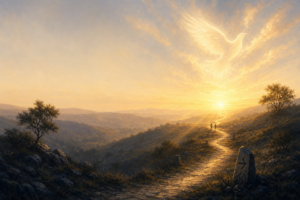
- It’s a suspension bridge stretched between two paths: the road behind through Galilee’s teaching and miracles, and the road ahead through table, shadow, cross, and empty tomb.
The air on that road into Jerusalem is electric. Branches wave. Cloaks are spread on the ground. Voices shout “Hosanna.” I imagine the disciples’ hearts pounding. “It’s happening. He’s finally being seen.”
And right beside the thrill is fear. Crowds are unpredictable. In the past, whenever Jesus has attracted attention, trouble has not been far behind. They are living in that place where exhilaration and terror are two sides of the same coin.
Psalm 118 and Zechariah 9: Right Words, Half‑Seen King
The people reach for the psalm they know best for occasions like this: Psalm 118.
- “Hosanna—save us now!”
- “Blessed is the one who comes in the name of the Lord!”
They are not wrong to sing it. They are right that Jesus is the one who comes in the name of the Lord. They sense that this is a moment of triumph, that God’s salvation is arriving.
But John quietly lets us know that a second Scripture is being fulfilled at the same time. He quotes Zechariah: “Fear not, daughter of Zion. See, your king is coming, seated on a donkey’s colt.”
Psalm 118 gives us the sound of the day—the joy, the noise, the celebration. Zechariah 9 gives us the shape of the King. This king is humble. He comes on a donkey, not on a war‑horse. He comes to bring peace, not to crush his enemies. He is still righteous and victorious, but in a very different way than many were expecting.
The crowd has the lyrics right, but the picture is incomplete. They can see Psalm 118. They cannot yet see Zechariah’s strange, gentle, peace‑making King. They want the visible win without the hidden cost. They want the Messiah who heals and feeds and teaches, but not the Messiah who suffers, is rejected, and dies.
That’s familiar territory for Peter. We heard it in Matthew 16. Peter loves Jesus. He believes he is the Messiah, the Son of the living God. But when Jesus starts to speak about suffering and being killed, Peter pulls him aside: “God forbid it, Lord. This must never happen to you.” He wants resurrection without Good Friday. He wants the crown without the thorns.
We do too, at least sometimes.
Duality in Jesus and in Life
Palm Sunday is a day of dualities.
King and Suffering Servant
Jesus truly comes as King—entering the royal city, fulfilling Scripture, receiving praise. At the very same time, he comes as Suffering Servant—walking steadily toward betrayal, trial, and cross.
Fully God and fully human
We also confess that he is both fully God and fully human. Only one who is fully God can save us. Only one who is fully human can stand in our place. On Palm Sunday, those two truths ride into Jerusalem on the same donkey.
Duality in us and in life
Duality is woven into life itself: life and death, fear and wonder, joy and sorrow. Palm Sunday spreads it all out in front of us: palms and praise on one side of the street, the shadow of the cross on the other. Even if the crowd and the disciples do not see it clearly, Jesus does. He enters the city, seeing it all—the celebration and the suffering, the welcome and the rejection, the death and the resurrection that will follow.
Think about those thresholds we cross in our own lives. When we are expecting a baby, we are exhilarated by the miracle that is happening, by the future that lies ahead—and at the same time, we may be terrified by the impending pain, by the fear of loving so hard, by the weight of responsibility. Death can feel strangely similar—the fear of what lies beyond, mixed sometimes with a quiet sense of peace and the nearness of Jesus.
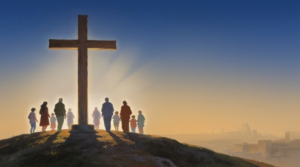
Palm Sunday holds both of those thresholds. It is the last quiet moment before the labor of the cross begins—the labor that will bring New Creation into the world. It is also the first clear step toward a very real death. In Jesus, God steps into both of those moments with us—into the joy and fear of new life, and into the fear and hope at the edge of death—so that neither birth nor death is ever faced alone.
“We Did Not Understand at First”
John adds an honest sentence to this story: “At first, his disciples did not understand all this. Only after Jesus was glorified did they realize that these things had been written about him and that these things had been done to him.”
Their bodies know something. Their hearts are pounding. But their minds do not yet see the whole picture.
Paul will later say it this way in 1 Corinthians 13: “Now we see in a mirror dimly… now I know in part; then I shall know fully, even as I am fully known.”
On Palm Sunday, the disciples know in part. They see Jesus, but they do not yet clearly see the cross and resurrection.
The comfort in Paul’s sentence is that little phrase “even as I am fully known.” Even while they only know in part, they are already fully known.
Jesus has already named impulsive, unsure Simon as Peter, the rock. He holds both identities at once—the wandering heart and the person Peter will become. That is how grace works with us too. We don’t see everything clearly. We don’t understand how all the pieces of our story fit together yet. But we are already fully known and fully loved by the One we are following.
If you feel like you don’t “get” all of this—King and Servant, cross and resurrection, grace and holiness—you are standing right where the first disciples stood on Palm Sunday. God isn’t waiting until you have a perfect understanding to walk with you into this week.
Many Roads, One Heart of Jesus
Every one of us walks into Jerusalem from a different starting point.
- An Amish farm in Pennsylvania.
- An underground house church in China.
- A charismatic community on the bayou in Louisiana.
- A Pentecostal congregation in a Mayan village in Guatemala.
- A progressive UCC church in Portland, Oregon.
- A Black church in Minneapolis, with call‑and‑response and organ‑driven praise.
- A solemn Latin Mass in New England.
- A small Methodist church in the rural mountains of central Virginia.
The landscapes are different—plains and cities, flag‑lined small towns and bike‑filled suburbs—but in the end, every road taken with Jesus bends toward the same heart.
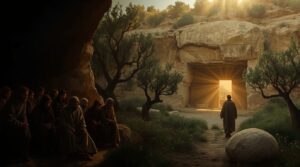
Palm Sunday gathers all those roads onto one street. There is one King riding the donkey. One Suffering Servant walking toward the cross. One risen Lord drawing us to the same table, the same cross, the same empty tomb.
Where Is Your Jerusalem?
Each of us will walk into our own “Jerusalem” this week.
For some, it might be a hard conversation that needs to happen.
For others, a strained relationship that needs honesty or forgiveness.
For some, a place of conflict or injustice, or a fresh grief or fear.
These are the places where the powers and principalities still push back. These are the streets where Jesus still walks.
Palm Sunday invites us to enter those places with the courage of Christ—owning the promise of the resurrection even when we feel afraid. It invites us to enter with a posture of love and grace—the donkey‑way rather than the war‑horse way: humility, truth‑telling, forgiveness, and mercy.
It invites us to let our songs of loudest praise become lives of loudest praise: public witness, acts of mercy, and reconciling love in Barboursville, Gordonsville, and wherever we go.
Staying on the Bridge
Palm Sunday does not ask us to have everything figured out. It invites us to step onto the suspension bridge with our wandering hearts, praising more than we understand, trusting that we are fully known by the One we follow.
As you walk into your own “Jerusalem” this week—whatever hard conversation, strained relationship, or fearful place that may be—may you go with the courage of Christ and the posture of his humble love, keeping company with the King who rides a donkey, the Suffering Servant who sees it all, and the risen Lord who will not let this story end in despair.