“In the beginning God created the heavens and the earth… the earth was formless and empty.”
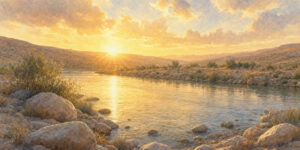
These words from Genesis are familiar to many of us. When I used to hear formless and empty, I imagined outer space — total nothingness. But the Hebrew words behind that phrase, tohu wabohu, describe something different: not empty space, but a wasteland — a desolate desert.
That image reshaped the way I hear Isaiah 35: “The wilderness and the dry land shall be glad; the desert shall rejoice and blossom.” Isaiah is not offering wishful thinking. He is proclaiming a new creation — God bringing life into desolation through the coming Messiah.
John the Baptist lived and breathed this promise. His entire identity was shaped by Isaiah’s vision: a voice crying out in the wilderness, preparing the way of the Lord. And yet, in Matthew’s Gospel, we meet John not in the wilderness but in prison. From that place of uncertainty, he sends a question to Jesus: “Are you the one who is to come?”
It is a faithful question — born not of disbelief, but of longing.
Jesus does not respond with an argument. Instead, he says, “Go and tell John what you hear and see.” The blind receive sight. The lame walk. The poor hear good news. In other words: look for the signs of new creation already breaking into the world.
Advent invites us to do the same.
Isaiah originally spoke to people who knew oppression, exile, and fear. Jesus spoke to people living under Roman rule and religious systems that favored the powerful. The gap between those with power and those without felt overwhelming.
Many people today experience something similar. Decisions that shape daily life often feel far beyond our reach. Anxiety, grief, financial pressure, and uncertainty leave us weary. Into that fear, Isaiah speaks a word of reassurance: “Be strong, do not fear! Here is your God.”
God’s justice is not distant or abstract. It is the fierce, protective love of a good parent — the assurance that we are not forgotten, even when the night feels long.
When we imagine God entering the world, we often expect spectacle. Yet Isaiah describes transformation not through catastrophe, but through water. Water works slowly and persistently, shaping landscapes over time. Rivers carve stone, rain smooths rock, and canyons are formed not by a single event but by faithful movement.
So it is with God.
John the Baptist was not powerful by the world’s standards. He wore camel’s hair, ate locusts and wild honey, and lived on the margins. Yet Jesus declares that no one greater had arisen. Like water transforming the wilderness, God worked through a modest messenger with a simple message.
Often we look for spotlights, but God works through flickers. The movement of God is frequently quiet and easily missed.
Isaiah tells us the signs of God’s kingdom are not strength and self-sufficiency, but healing, restoration, and good news for the poor. Jesus points to the blind seeing, the lame walking, and the vulnerable being made whole.
The kingdom is revealed not through perfection, but through humility. Shepherds hear angels. Women proclaim resurrection. Outsiders become witnesses.
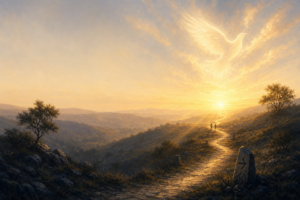
During Advent, we walk the Holy Way together. Even in chaos and darkness, we keep moving toward hope, trusting that God brings new life from tohu wabohu. We slow down to notice water breaking through stone. We walk knowing there is room for our brokenness and questions.
And as we walk, we become signposts ourselves — pointing not to our strength, but to Emmanuel: God with us.