A reflection on hinge moments and Pentecost
Rev. Joyce Rodgers
May 24, 2026
When Life Shifts – Week 1 | Acts 2:1–21
There are seasons when life feels like it is coming apart and coming together at the same time. You can sense that something is changing, but you cannot quite see what the next chapter will look like yet.
Over these next weeks in worship, we are calling this series When Life Shifts because Scripture is full of people standing exactly where many of us find ourselves now: in the middle of change, on the edge of something we cannot fully see, discovering who God is in that in‑between space.
Before we move into what this means for us, I want to start with an image.
A folding ruler and a hinge
I brought a folding ruler to worship as a kind of parable. Folded up, it looks small and compact, almost forgettable, but every segment of that ruler is already there. Nothing needs to be added for it to reach its full length; it simply has not been unfolded yet.
The problem, of course, is that a folded ruler cannot reach anything. It cannot measure, cannot stretch, cannot do what it was made to do until it begins to open at the hinges.
That is how I’ve been thinking about this moment in the life of our congregation and in many of our lives. We are standing at a hinge: a pastoral transition in just a few weeks, baptisms and confirmations for some, and quiet, personal shifts for others that maybe no one else fully sees.
Here is what matters: a hinge doesn’t erase what came before. It doesn’t replace the earlier segments of the ruler; it holds them and lets them extend. Nothing is being thrown away. The ruler is simply opening.
The in‑between room
The story we hear on Pentecost begins in an upper room with one hundred and twenty people who have already seen more change in a few weeks than many of us see in years. They have followed Jesus, watched him die, encountered him risen from the dead, and then watched him ascend, promising that the Holy Spirit would come.
They wait in that strange in‑between where the life they knew has ended and the life they are called into has not started yet. The rhythms they once trusted are gone; the new rhythms have not formed. That in‑between space can be one of the most disorienting places a person—or a church—can be.
But they stay. They wait together. I imagine the low hum of conversation, prayers whispered and spoken, people who have survived something enormous trying to put words around it. Then, suddenly, the air changes.
When the air shifts
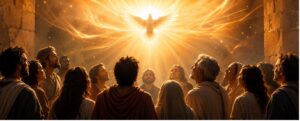
Acts tells us there is “a sound like the rush of a violent wind,” and it fills the entire house where they are sitting. Conversations stop mid‑sentence. Hearts pound before minds can catch up. Then tongues of fire appear and rest on each person—fishermen, women who stood at the cross, and everyone in between.
The adrenaline of waiting becomes the adrenaline of arrival. They begin speaking in languages they never learned, and suddenly the streets outside are filled with people hearing the good news in their own mother tongue—Parthians, Medes, Egyptians, Romans, all hearing in the language they dream in.
The crowd’s question is a good one: “What does this mean?” That is often the question we ask when life begins to shift around us.
Peter at the hinge
What happens next still astonishes me: Peter stands up to preach. This is the same Peter who, not long before, was hiding in fear and denying he even knew Jesus. If you were picking a likely candidate to address a crowd of thousands, Peter might not make the short list.
But the Spirit does not wait for us to feel ready. The Spirit moves, and suddenly the person who was sure they could not do this discovers that, by grace, they can. Not because they have become someone entirely different, but because they are finally stepping into who they already were in God’s eyes.
Peter’s sermon does something vital for anyone living through a hinge moment. He does not say, “Something utterly new is happening and God has never spoken of this before.” Instead, he reaches back to the prophet Joel: “This is what was spoken through the prophet Joel…”
In other words: this is not chaos. This is fulfillment.
The long arc and the hidden blueprint
The prophets are full of hinge moments: people standing in change they did not choose, disruption they did not plan, transitions that made the ground feel like it had shifted beneath their feet. Over and over, they testify that none of it catches God off guard.
What feels brand new to us is never new to God. Every shift, every hinge, every moment when the world looks different than it did yesterday is part of a longer arc bending toward restoration and wholeness. We may not be able to see the full length of the ruler from where we stand, but God can—and God has been holding it the whole time.
Joel’s words had been waiting on the page for generations: “In the last days, God declares, I will pour out my Spirit upon all flesh…” Sons and daughters, old and young, servants and free; no one is left out of the reach of the Spirit. The Kingdom was never small. It only looked small because we had not reached that hinge yet.
One hundred and twenty becomes three thousand
On that Pentecost day, one hundred and twenty becomes three thousand in a single day. Those three thousand go home again—to Parthia and Egypt and Rome and their ordinary lives—but they are not the same people who arrived in Jerusalem. They have encountered the living God through the Holy Spirit, and that encounter begins to change how they live, love, choose, forgive, and hope.
That kind of transformation is not easy. It puts people at odds with the world around them, sometimes even with the versions of themselves they used to be. But the Kingdom has no walls now; it travels in people. Each person becomes the next segment of the ruler extending into the world.
Our congregation at a hinge
For our congregation, this is its own hinge moment. A pastoral transition carries real tenderness. Relationships have been formed, ministries have been built, lives have been woven together in this place, and none of that disappears when a new appointment begins.
Every Bible study, every funeral, every shared meal, every act of service, every baptism—it is all part of the ruler. Those segments remain structural; they are what make the next segment possible. The next chapter of this church’s story will stand on what has already been faithfully built here.
For me as a pastor, this is also deeply personal. Leaving people you have come to love is never simple, even when you trust that God is calling you and the church into the next faithful step. I am holding Gordonsville and Barboursville in my heart, trusting that the God who cared for you long before I arrived will go on caring for you long after I go.
And I am trusting that the place I am being sent is exactly where God needs me next, even though I cannot yet see the whole picture. That is the nature of a hinge: you cannot fully see the next segment until you begin to extend.
Baptism, confirmation, and personal hinges
Some of you are standing at very personal hinges. Those being baptized are saying a first, courageous yes to grace, to this community, and to a life shaped by something larger than themselves. Those being confirmed are taking on the responsibility and the gift that come with that yes.
It is not a small thing to step into the water or to stand up and own the vows spoken over you. It is an enormous thing. On the day of Pentecost, the same Spirit who filled that upper room sent people out into a world that would not always understand them. Yet they walked forward, because they trusted that the One who called them was already ahead of them in every place they would go.
None of this was without risk; none of it was without fear. But the gift poured out at Pentecost—and still poured out today—is the assurance that we are not wandering aimlessly through our changes. We are being led.
Growing points, not breaking points
When I imagine the folding ruler fully extended, I see a visual reminder of what God does with our lives and with the Church. God does not throw away segments. Each chapter, each season, each relationship, each ministry becomes part of a longer reach.
Every hinge—every Spirit‑led change—is not a breaking point. It is a growing point.
In the weeks ahead, as we celebrate baptisms and confirmations, as we say goodbye and hello, as we step into new roles and rhythms, I invite you to see these moments as hinges in the hands of a faithful God. The same Spirit who rushed into that upper room and set hearts on fire is still breathing courage, still extending the reach of the Kingdom, still meeting people right where they stand on the threshold of what comes next.
We are not replacing anything. We are extending the reach. The Kingdom was all there all along. Today—another hinge, another extension, another reach into the world.
This is the sermon manuscript from Sunday, May 24, 2026, part of our Pentecost series “When Life Shifts” at Barboursville UMC and Gordonsville UMC